

Why Choosing a True Local Raised Floor Manufacturer Matters for Your Project Timelines

Why Choosing Saudi Arabia Real Manufacturer Of Raised Floor System Matters
When project deadlines are tight, every supplier decision matters. This is particularly true for raised access flooring, where late delivery of panels, pedestals, stringers, or accessories can prevent several other trades from completing their work.
For contractors, consultants, fit-out companies, data center developers, MEP contractors, and project owners, choosing a true raised floor system manufacturer can make a significant difference to project timelines.
The challenge is that not every company presenting itself as a manufacturer actually manufactures raised flooring locally.
Some businesses operate primarily as traders, distributors, resellers, or middlemen while marketing themselves in a way that can make customers assume they are direct manufacturers. In some cases, these suppliers do not maintain meaningful local inventory. Once a project inquiry or purchase order is received, the required material must first be sourced or imported—sometimes from neighboring markets such as Saudi Arabia.
That difference may not appear important during the quotation stage. It becomes extremely important when the project requires material immediately.
Understanding who actually manufactures your raised floor system, where the stock is located, and how quickly it can be delivered can protect your project from unnecessary delays.
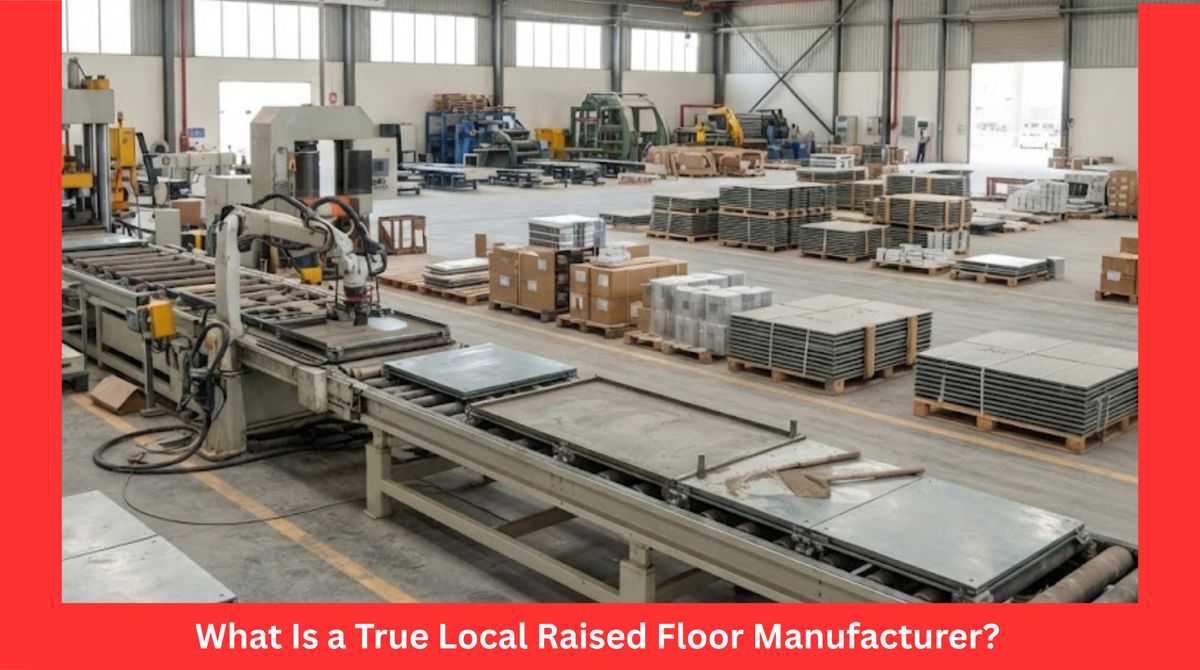
What Is a True Local Raised Floor Manufacturer?
A true local raised floor manufacturer is a company that actually produces raised flooring products within the local market, rather than simply buying finished products from another manufacturer and reselling them.
Depending on the product range, local manufacturing may include the production or assembly of:
- Raised access floor panels
- Cement-filled steel panels
- Calcium sulphate panels
- Pedestal systems
- Stringers
- Understructure components
- Raised floor accessories
- Customized flooring components
The important distinction is manufacturing capability.
A supplier may have a local office, sales team, warehouse address, website, and local commercial registration without necessarily manufacturing the product locally.
This distinction directly affects stock availability, lead times, replacement material, customization, and the supplier’s ability to react when project requirements change.
The Problem With Fake Manufacturers and Resellers
One of the biggest challenges customers face in the raised flooring market is identifying whether a company is a genuine manufacturer or simply a reseller.
There is nothing inherently wrong with purchasing from a distributor or reseller when the business is transparent about its role and has sufficient inventory. Problems arise when a supplier presents itself as a direct or local manufacturer even though the actual products are sourced from a third party.
This can create a misleading impression about production capacity and product availability.
A customer may reasonably assume that a company describing itself as a local raised floor manufacturer can manufacture or supply additional material quickly. But if that company depends entirely on another factory, its ability to deliver is controlled by someone else’s stock, production schedule, transportation arrangements, and border logistics.
The quotation might look competitive, and the promised delivery period may initially sound reasonable. However, the true supply chain is often revealed only after an order is placed.
That is why buyers should look beyond marketing claims.
Instead of asking only:
“Are you a manufacturer?”
Ask:
“Where is your factory, where is this material manufactured, and can you show me the available local stock?”
Those questions provide far more useful information.
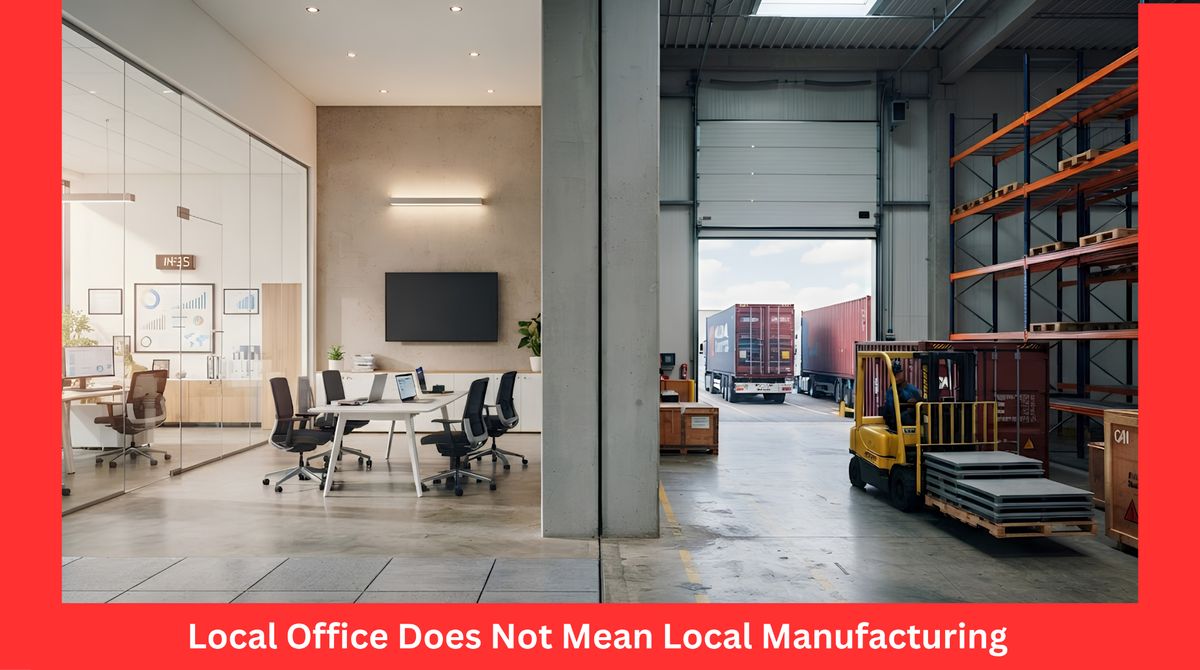
Local Office Does Not Mean Local Manufacturing
A common misconception is that a company operating locally must also manufacture locally.
That is not necessarily the case.
A raised floor supplier can have a local sales office and still source every panel, pedestal, and accessory from another country.
The difference matters because the customer’s timeline depends on the physical location of the material—not the location of the salesperson.
Before placing an order, determine whether the supplier:
- Operates an actual production facility
- Maintains inventory locally
- Produces the quoted raised flooring system itself
- Depends on a third-party manufacturer
- Imports material only after receiving confirmed orders
A genuine local presence should provide more than a local telephone number and quotation.
For time-sensitive projects, customers need local production capability and/or verified ready stock.
Lack of Local Stock Creates a Serious Project Risk
Stock availability is one of the most important factors when selecting a raised floor supplier.
Some suppliers operate with little or no ready stock because keeping inventory requires warehouse space, working capital, forecasting, and operational investment. Instead, they may source products only after securing a customer order.
For the supplier, this business model can reduce inventory costs.
For the customer, it transfers a significant portion of the supply-chain risk directly to the project.
Imagine a contractor requires 2,000 square meters of raised access flooring within the next several days. A supplier sends a competitive quotation and wins the order.
Only after the purchase order is issued does the contractor discover that the material is not physically available locally.
The supplier now has to arrange the stock from another source.
If the product is being sourced from Saudi Arabia, for example, the supplier may need to coordinate:
- Stock confirmation with the external manufacturer or warehouse
- Commercial documentation
- Product collection
- Truck availability
- Export procedures
- Cross-border transportation
- Customs clearance
- Local delivery arrangements
Any issue within this chain can extend the delivery timeline.
A product that appeared to be available during the quotation stage may suddenly require days or weeks to reach the project site.
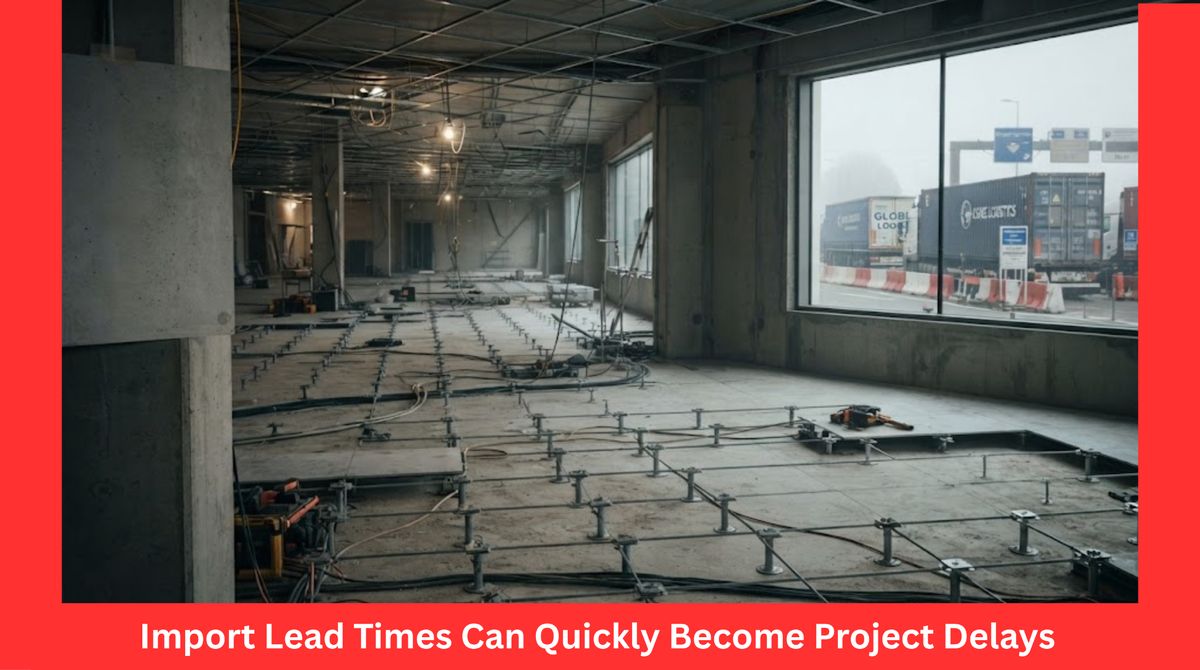
Import Lead Times Can Quickly Become Project Delays
International and cross-border sourcing is a normal part of the construction supply chain. However, importing material after receiving a time-sensitive project order creates additional uncertainty.
The supplier may initially estimate a certain delivery period, but several factors can influence the actual arrival date.
Transportation schedules can change. Customs documentation can require additional processing. Trucks can be delayed. Stock previously expected from the overseas source may become unavailable. Public holidays and administrative procedures can add additional time.
Even a relatively short delay can have a substantial effect on a fast-track project.
Raised flooring often needs to be installed before other activities can proceed, especially in:
- Data centers
- Server rooms
- Control rooms
- Command centers
- Offices
- Telecommunications facilities
- Electrical rooms
- Commercial fit-outs
- Technical facilities
If the raised floor installation is delayed, downstream activities may also be delayed.
That means a material procurement issue can become a scheduling issue for multiple contractors.
How Raised Floor Delivery Delays Affect the Entire Project
A raised access floor is rarely an isolated item.
It is typically integrated into a larger project schedule involving MEP services, cabling, containment, partitions, furniture, equipment installation, testing, and commissioning.
Suppose the raised floor material arrives one week late.
The flooring contractor may lose its scheduled installation window. Other trades may already have labor booked for the following week. Equipment installation may need to be rescheduled. Testing and commissioning may move further into the future.
The project team then has to coordinate multiple revised activities because of a single procurement delay.
Possible consequences include:
- Installation delays
- Idle labor
- Rescheduling of subcontractors
- Additional mobilization costs
- Delayed equipment installation
- Missed project milestones
- Extended site overheads
- Disruption to testing and commissioning
- Increased pressure on project managers
- Potential contractual penalties
The lowest-priced raised floor quotation can therefore become much more expensive if material availability causes project disruption.
Procurement teams should evaluate delivery reliability, not simply unit price.
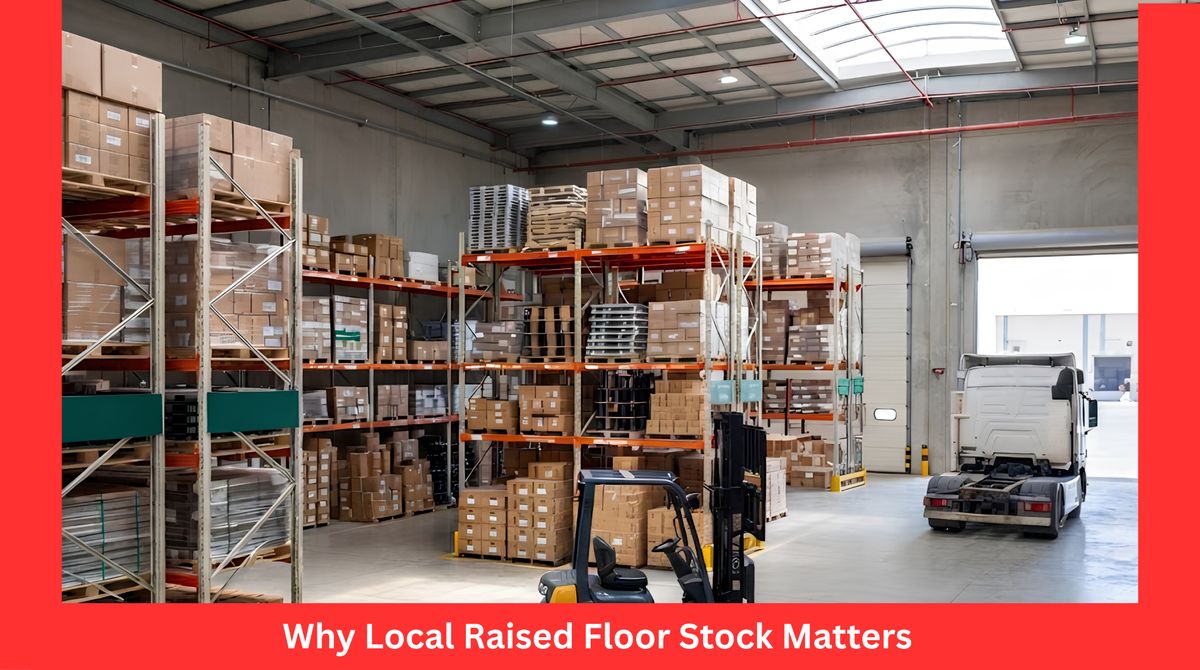
Why Local Raised Floor Stock Matters
Working with a manufacturer that maintains local raised floor stock provides a significant advantage.
When material is physically available nearby, delivery becomes simpler and more predictable.
Instead of waiting for an international supply chain to move, the manufacturer may be able to allocate stock directly to the project and arrange transportation immediately.
Local inventory can provide several benefits:
Faster Delivery
Ready stock can dramatically shorten the period between purchase order and site delivery.
Greater Schedule Reliability
There are fewer transportation and customs variables affecting the delivery date.
Faster Response to Additional Requirements
Construction quantities frequently change.
A project might initially require 2,000 square meters and later need another 150 square meters because of design changes or revised room layouts.
A manufacturer with local stock can often respond far faster than a supplier who must initiate another import.
Easier Replacement of Damaged Components
Panels or understructure components may occasionally need replacement during installation or later operation.
Local availability makes obtaining replacement products easier.
Reduced Procurement Risk
Project teams gain greater confidence that the required material actually exists and can be supplied when promised.
Never Assume Stock Is Available—Verify It
One of the most important steps customers can take is extremely simple:
Verify stock availability before finalizing the order.
Do not rely solely on phrases such as:
- “Available”
- “Fast delivery”
- “Ready supply”
- “Immediate delivery”
- “Stock available”
Ask for specific confirmation.
For example:
“Is the complete quantity physically available in your local warehouse today?”
If the answer is yes, request supporting evidence where appropriate.
Depending on the project size, buyers may request:
- Warehouse inspection
- Stock photographs
- Batch information
- Inventory confirmation
- Factory visit
- Product inspection
- Written stock confirmation with the quotation
For major projects, physically visiting the factory or warehouse can be particularly valuable.
A short verification exercise before placing the purchase order can prevent a much larger problem later.
How to Identify a True Local Raised Floor Manufacturer
Customers should conduct basic due diligence before selecting a raised floor manufacturer.
1. Ask for the Factory Location
Request the physical address of the manufacturing facility.
A genuine manufacturer should be able to explain where its products are produced.
2. Visit the Manufacturing Facility
For significant orders, consider arranging a factory visit.
Seeing manufacturing machinery, raw materials, production processes, workers, quality-control procedures, and finished stock provides far stronger evidence than marketing materials alone.
3. Ask Who Actually Manufactures the Product
Ask directly:
“Is your company manufacturing this product, or are you sourcing it from another manufacturer?”
The answer should be clear.
4. Verify Local Stock
Ask exactly how much of the required specification is currently available.
Stock of a different panel type, height, load rating, or finish does not solve your project’s requirement.
5. Confirm Manufacturing Lead Time
If the complete quantity is not currently in stock, ask how quickly additional units can actually be manufactured.
A local manufacturer may be able to start production directly, while a reseller must first coordinate with an external manufacturer.
6. Ask About Product Origin
Request confirmation of the country of manufacture.
This helps prevent confusion between a locally marketed product and a locally manufactured product.
7. Check Technical Documentation
Review relevant product information, test certificates, load ratings, specifications, and quality documentation.
The documentation should correspond to the product being offered.
True Local Manufacturing Provides More Than Faster Delivery
Delivery speed is important, but local manufacturing offers additional operational advantages.
A true manufacturer has greater control over production.
If a project suddenly requires additional quantities, the manufacturer may be able to schedule another production run without depending entirely on an overseas supplier.
If a technical issue arises, communication is also more direct. The customer can speak with the organization responsible for manufacturing rather than having questions pass through several layers of intermediaries.
Local manufacturing can also improve:
- Production visibility
- Quality-control access
- Technical coordination
- Customization
- Replacement availability
- Additional quantity fulfillment
- After-sales support
- Supply-chain transparency
For contractors managing demanding project deadlines, this responsiveness can be extremely valuable.
Manufacturer vs. Reseller: Understand the Difference Before You Order
The objective is not to suggest that every reseller provides poor service. Many professional distributors maintain substantial inventory and provide excellent technical support.
The important issue is transparency.
Customers should know who they are actually buying from and where their products are actually coming from.
A reseller with confirmed local stock may be perfectly capable of meeting a project’s requirements.
A supplier with no stock, no production capability, and complete dependence on overseas sourcing represents a different level of risk.
Therefore, procurement teams should evaluate three separate questions:
Who manufactures the product?
Where is the product manufactured?
Where is the required quantity physically located right now?
Those three answers provide a much clearer picture of potential delivery risk.
What Contractors Should Ask Before Issuing a Purchase Order
Before finalizing any raised access flooring order, use the following checklist:
- Are you the actual manufacturer of the raised floor system?
- Where is your manufacturing facility located?
- Can we visit the factory?
- Is our complete required quantity currently available locally?
- Where is the stock physically stored?
- Can we inspect the stock before ordering?
- What is the country of origin?
- If additional material is required, how quickly can you manufacture or supply it?
- Do you depend on imports to fulfill this order?
- Is the promised delivery period stated in writing?
- Are the required pedestals, stringers, accessories, and panels all available?
- Can you provide the relevant technical documentation and test reports?
These questions take very little time to ask but can expose important supply-chain risks before they affect the project.
Price Should Not Be the Only Procurement Decision
Construction procurement naturally focuses on cost, but choosing a raised flooring system based only on the cheapest quotation can be risky.
Consider two suppliers.
Supplier A offers a slightly lower price but does not hold local stock. Material must be sourced internationally after the purchase order.
Supplier B is a true local manufacturer with the required products either already in stock or supported by immediate local production capacity.
The initial quotation from Supplier A may appear more attractive.
However, if the material arrives late and causes installation crews, subcontractors, or commissioning activities to be rescheduled, the project’s actual cost can quickly exceed the initial saving.
The best purchasing decision therefore considers:
Price + Quality + Stock Availability + Delivery Reliability + Manufacturing Capability + Technical Support
Not price alone.
Frequently Asked Questions About Local Raised Floor Manufacturers
Why should I choose a local raised floor manufacturer?
A local raised floor manufacturer can provide greater control over production, shorter supply chains, faster replacement material, better visibility of available inventory, and potentially more reliable project delivery.
How can I verify whether a raised floor supplier is a real manufacturer?
Ask for the factory address, request a factory visit, confirm the country of manufacture, inspect production capabilities, review technical documentation, and verify whether the company physically produces the products it sells.
Why is local raised floor stock important?
Local stock reduces dependence on international transport and customs processes. It can also allow faster delivery when projects have urgent requirements or when additional quantities are needed unexpectedly.
Should I avoid all raised floor resellers?
Not necessarily. Reliable distributors and resellers can provide excellent service, particularly when they maintain sufficient local stock. The key is knowing whether you are dealing with a manufacturer or reseller and verifying stock availability before ordering.
What should I check before buying raised access flooring?
Confirm the manufacturer, manufacturing location, country of origin, product specification, available quantity, warehouse location, delivery timeline, technical documentation, and availability of panels, pedestals, stringers, and required accessories.
What happens if my raised floor supplier has no local stock?
The supplier may have to manufacture, source, or import the material after receiving your order. Depending on the source location and logistics, this can introduce additional lead time and increase the risk of project delays.
Protect Your Project Timeline Before You Place the Order
A raised floor system may represent only one package within a major construction or fit-out project, but its late arrival can affect many other activities.
That is why supplier verification should happen before the purchase order is issued—not after the project is already waiting for material.
Do not assume that every business using the term “manufacturer” actually operates a local manufacturing facility. Do not assume that a local office means the required products are stored locally. And most importantly, do not assume that quoted material is ready for delivery without verifying stock.
Ask where the product is manufactured.
Ask who manufactures it.
Ask where the stock is physically located.
Ask to see the factory or warehouse when necessary.
And obtain clear confirmation of stock availability before committing to an order.
Choosing a true local raised floor manufacturer gives your project something more valuable than convenience: greater control over the supply chain.
With genuine local manufacturing, verified inventory, transparent production capabilities, and faster access to additional material, contractors and project owners can reduce procurement uncertainty and protect critical delivery schedules.
When your project timeline depends on raised flooring arriving on time, the question should not simply be:
“Who can give me the lowest price?”
It should be:
“Who can prove they have the manufacturing capability, stock availability, and supply-chain control to deliver when my project actually needs it?”
That is the difference between selecting a supplier and selecting a reliable manufacturing partner.
Conclusion
Choosing a true raised floor system manufacturer can make a major difference to your project’s delivery timeline, supply reliability, and overall risk. A supplier may claim to be a manufacturer, but if the material must be imported only after receiving your order, unexpected logistics, customs, and stock issues can quickly delay the project.
Before finalizing any purchase, always verify where the raised floor is manufactured, confirm that the required quantity is physically available locally, and check whether the company genuinely operates its own manufacturing facility. For larger projects, requesting a factory or warehouse visit can provide additional confidence.