

Saudi Arabia’s Raised Floor Solutions: The Ultimate Guide to Modern Raised Flooring Infrastructure
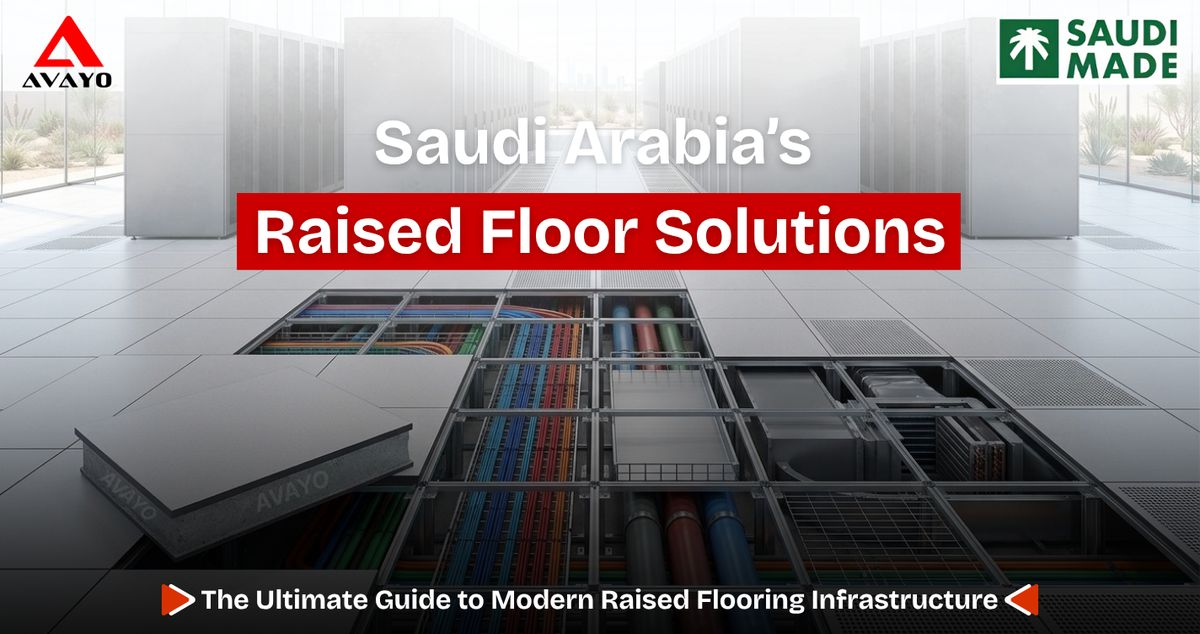
Saudi Arabia is changing faster than ever before. Vision 2030 is transforming cities, pushing a digital economy and sparking massive investment in data centers, smart offices, government buildings, raised floor and mega projects such as NEOM, Red Sea and KAFD. But this modern infrastructure is underpinned by raised access flooring, an essential, but often overlooked system.
Raised floor options create a flexible, accessible void beneath the finished floor. This space stores power cables, data networks, HVAC systems, and other services while permitting effective cooling, easy maintenance, and future improvements. In a Kingdom confronting high heat, rapid technological change, and strict project timeframes, raised floors have become crucial.
This comprehensive guide explains everything you need to know about raised floor solutions in Saudi Arabia — from how they work and why they matter, to types, benefits, applications, standards, selection criteria, and how local manufacturers like AVAYO deliver reliable systems for the Kingdom’s most demanding projects.
What Is a Raised Floor System?
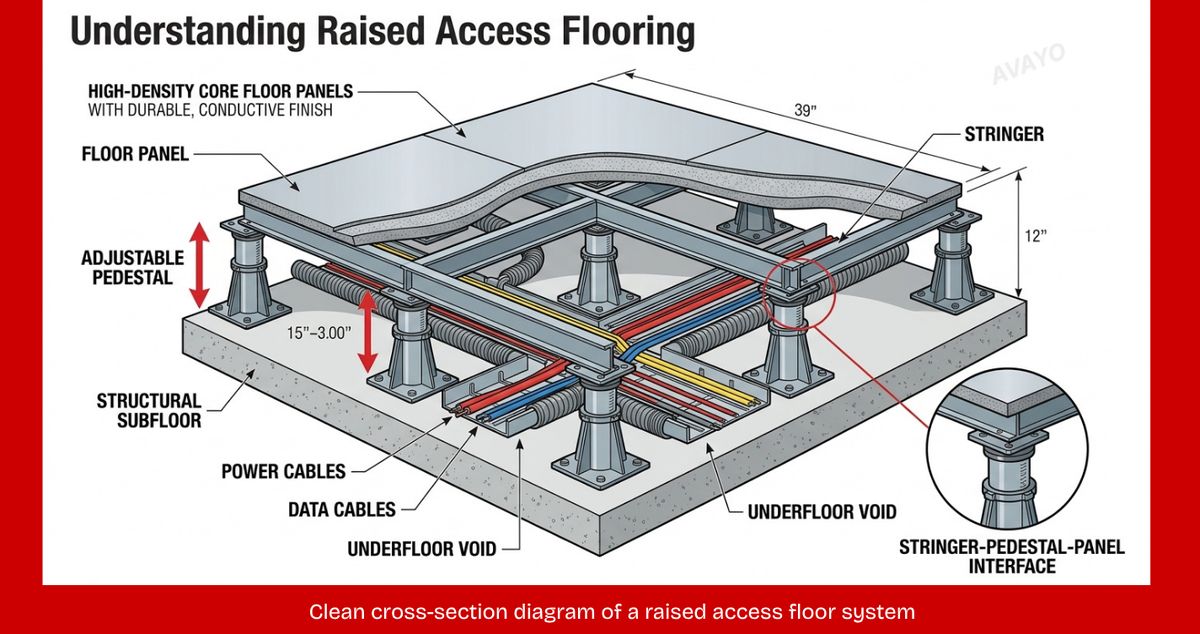
A raised floor (sometimes termed raised access floor or access flooring) is an elevated flooring system constructed above the structural concrete slab. Adjustable steel pedestals support modular panels (usually 600 × 600 mm), producing a plenum or void underneath. The height of this vacuum normally ranges from 100 mm for low-profile office applications to 1,000–1,500 mm for data centers and technical rooms.
Key components include:
- Panels: The walking surface, available in numerous core materials and finishes.
- Pedestals: Adjustable supports fixed to the subfloor that provide exact leveling.
Stringers (optional) – Horizontal pieces that link pedestals for enhanced rigidity and load distribution.
- Accessories: Floor boxes, grilles, ramps, and edge details.
Panels can be removed individually for rapid access to the services below. This versatility is what makes raised floors better to typical slab-embedded services for modern, technology-driven structures.
Why Saudi Arabia Must Have Raised Floors in Its Infrastructure
In the specific conditions of Saudi Arabia, elevated flooring are especially useful.
Climate and energy efficiency
Cooling bills go up during extreme heat. Underfloor Air Distribution (UFAD) systems employ the space beneath the elevated floor to efficiently send cold air upwards from below, enhancing thermal comfort and saving energy over standard overhead systems. This is consistent with the national sustainability goals and Vision 2030 goals for efficient structures.
Data center growth and digital transition
The Kingdom is aggressively building out its digital infrastructure. Hyperscale and enterprise data centers require thick cabling, high load capacity server racks, accurate airflow management and anti-static qualities. All these needs can be met with raised floors and can be readily reconfigured as technology changes.
Vision 2030 Mega Projects
Projects like NEOM, Red Sea Global, Diriyah Gate and mega-developments in Riyadh, Jeddah and Dammam, need flexible infrastructure that is future-proof. Raised floors offer dynamic workspaces, smart building technologies and changing MEP requirements without large structural alterations.
Local content and pace of projects
Manufacturing in Saudi Arabia shortens lead times, satisfies local content requirements and offers quicker response on large or urgent projects. Companies such as AVAYO, with in-Kingdom production, ISO certification and Aramco clearance are ideally positioned to satisfy these needs.
Flexibility to change work places
Modern offices and government facilities demand periodic changes in layout. Raised floors let you easily move power and data points by simply lifting panels and relocating floor boxes – far simpler and less disruptive than cutting into concrete or chasing walls.
Types of Raised Floor Panels Offered in Saudi Arabia
The sort of panel required will depend on the application. Leading manufacturers in the Kingdom offer a few key options:
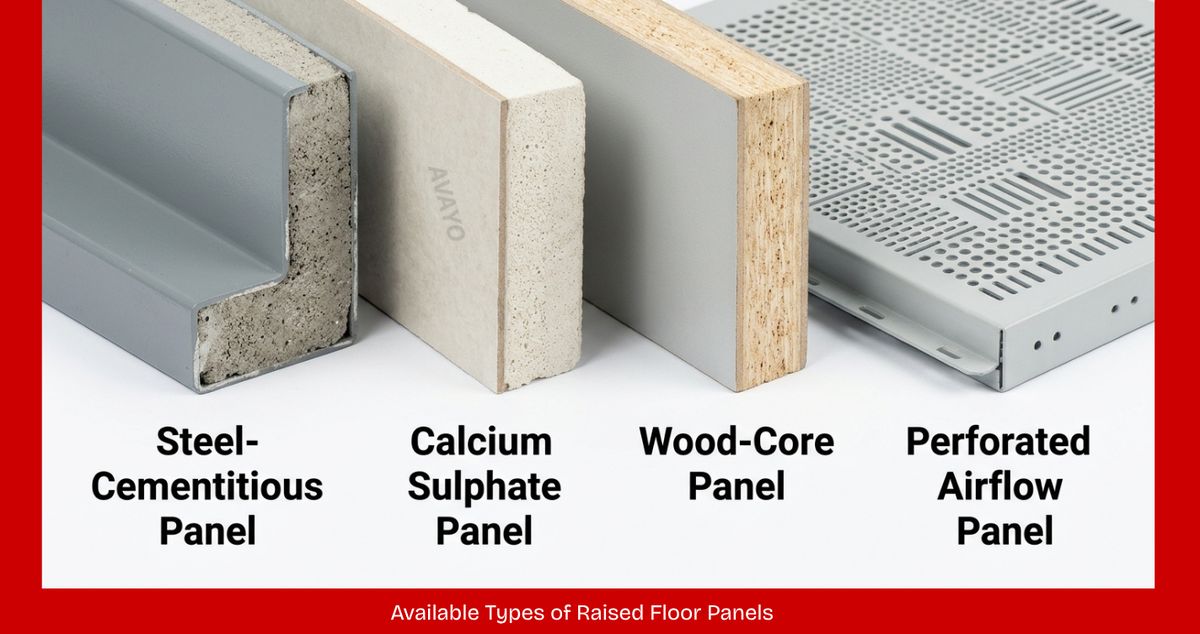
Steel-cementitious (encapsulated steel) panel
They’re steel shells filled with lightweight cement. They have good load-bearing capacity, fire resistance, dimensional stability and acoustic performance. Ideal for data centers, server rooms, control rooms and high traffic commercial areas. These systems produce high concentrated and homogenous loads, suited for heavy equipment.
Calcium sulfate boards
Firm core of calcium sulfate linked to galvanized steel. These provide better moisture resistance, sound dampening, low emissions and good load performance. They are the ideal choice for mission critical locations and where high fire ratings and acoustic control are desired.
Woodcore panels (chipboard)
High density chipboard cores completely encapsulated in galvanized steel. Economical and ideal for general office applications where moderate loads and frequent reconfiguration are expected. Available in a variety of finishes and good dimensional stability when properly protected.
Ventilation / perforated panels
Designed specifically with precision perforations (often 20% or 40% open area) to allow controlled airflow from the underfloor plenum. Critical to data center cooling strategies. They provide structural strength and excellent thermal management.
Alternate alternatives
Lightweight or cleanroom applications Aluminum panels and unique systems such as corner-lock designs for maximum stability and exact alignment.
Common finishes include bare (for site-applied coverings), high-pressure laminate (HPL), vinyl/PVC (with anti-static), and carpet tiles. In IT and sensitive equipment regions, anti-static and conductive versions are needed.
Advantages of Raised Floor Systems
Performance, operations and cost are actual benefits of raised floors:
- Better cable and services management: All power, data, fiber and sometimes HVAC and pipes are contained in the plenum, avoiding surface clutter and trip hazards.
- Easy access and maintenance: Panels may be lifted rapidly for inspection, repair or upgrade with minimal inconvenience.
- Increased efficiency of cooling: UFAD systems offer better temperature management and can reduce energy use in Saudi Arabia’s hot climate.
- High load capacity and durability: Engineered systems accommodate massive server racks, office furniture and dynamic loads and retain long service life.
- Flexibility and future-proofing: Spaces can be altered without major construction.
- Improved esthetics and work environment: Clean, professional interiors with integrated power and data access via floor boxes.
- Acoustic and fire performance: Properly configured systems help to create calmer surroundings and meet fire safety criteria.
- Sustainability Contribution: Enables energy-efficient cooling and potential green building certifications through effective material usage and durability.
All Over Saudi Arabia – Main Uses
Raised flooring are used in several different sectors:
- Data Centers and Server Rooms: The classic use. High load panels, perforated tiles for cooling, ESD protection and deep plenums for dense cabling and ventilation.
- Corporate Offices & Headquarters: Flexible power/data distribution, clean esthetics and support for agile workspaces in the commercial centers of Riyadh, Jeddah and Dammam.
- Government and public buildings: Reliable infrastructures that meet stringent criteria for ministries and official buildings.
- Control rooms: Command centers and telecom facilities with high load capacity, organized cabling and reliable performance for important operations.
- Commercial and mixed-use developments: Integrate into modern buildings that promote Vision 2030 growth.
- Industrial & Technical: Tough solutions for settings with heavy equipment or specialist services.
AVAYO systems are designed and built specifically for these applications in Riyadh, Jeddah, Dammam and all major project sites in the country.

Saudi Arabia Standards, Certifications and Compliance:
There is no talk about quality and compliance. The reputable raised floor systems in the Kingdom are manufactured to international standards such as EN 12825 (raised access floors) and CISCA rules on load classes, deflection, impact resistance and dimensional accuracy. Fire performance is assessed using approved procedures and manufacture often bears ISO 9001:2015 certification.
Local requirements include SASO (if applicable), Saudi Building Code considerations and project specific permits (e.g. Saudi Aramco specifications). Technical submittals, load calculations, shop drawings and complete manufacturers documentation are easily approved by consultants and contractors.
AVAYO said ISO manufacturing, testing to CISCA and EN 12825, SASO and Aramco approvals are vital credentials for government, energy and mega-project operations.
Choosing the right raised floor system
Choosing the right system calls for thorough evaluation:
- Load requirements: Establish concentrated (point), uniform and ultimate loads, based on equipment and traffic. Data centers are more demanding than standard office buildings.
- Plenum height: Match height to the number of services and UFAD requirements (low profile for offices, deeper for technical rooms).
- Environmental and performance specifications: Moisture, fire rating, acoustics, static control and air flow.
- Finish & Esthetics: Should match interior design, but durability and cleanability are important.
- Frequency of reconfiguration and accessibility: Full access systems are desirable when changes are expected often.
- Project timeframe and supply chain: Local manufacturing shortens lead times and enables speedier delivery.
- Total Cost of Ownership: Look beyond the initial panel pricing and consider installation speed, ease of maintenance, energy savings and longevity.
- Supplier capabilities: Look for help with design, technical documentation, installation and after-sales service.
Partnering with a local, experienced manufacturer early in the design process will assist optimize the system for performance and budget.
Installation Notes
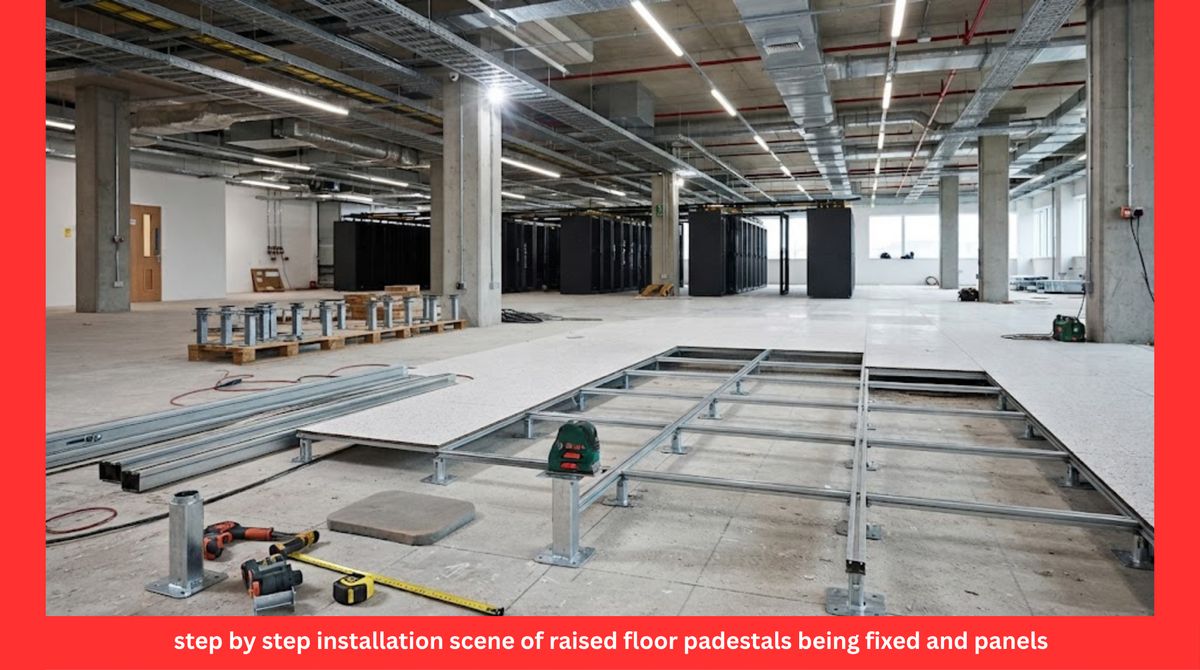
A professional installation is important for long-term functioning. Typically, the process involves:
- Site survey and preparation of subfloor
- Fixing the layout and pedestal (adhesive or mechanical)
- Stringer installation as needed
- Panel leveling and placement
- Floor boxes and edges Cutting for impediments
- Final inspection and load check if required
Pedestals must be correctly set to obtain a level final floor. Good edge details, ramps at transitions and coordination with other building systems (doors, partitions, ceilings) provide a seamless result. “The best outcomes are delivered by experienced teams who know the project conditions in Saudi.
Raised Floor Cost Components in Saudi Arabia
The price will depend on the kind of panel (cementitious, calcium sulfate or wood core), load rating, finish, height of pedestals, size of project and any unique needs such as perforation or ESD features. Economies of scale are good for larger undertakings. For fully imported systems, local manufacturing and supply often offers advantages in logistics and lead time.
The real value is in the lower cost of future disruption, energy efficiency and the capacity to change spaces throughout the decades of a building’s life.” Always ask for project specific prices with precise technical specifications.
The Avayo Advantage – Why Local Knowledge Matters
AVAYO is a Saudi designer, manufacturer and supplier of raised access flooring solutions, working on projects in Riyadh, Jeddah, Dammam and key Vision 2030 initiatives. Strong points include:
- In-Kingdom manufacture for quality control and speedier delivery.
- ISO 9001:2015 Certified Process.
- Systems tested according to international standards (CISCA, EN 12825) and according to SASO requirements.
.
- Experience and Aramco approval of large infrastructure requirements.
- Complete product range Steel-cementitious, calcium sulfate, wood core and airflow/perforated panels.
- Load calculations, help with shop drawings and technical submittals.
- Ability to service data centers, offices, government and industrial facilities.
- Complementary goods such as floor boxes and associated infrastructure solutions.
A local presence means quick support, lower supply-chain risk and procedures designed for the Kingdom’s climate and project reality.
Maintenance & Life Span
The raised floor system is designed for decades of low maintenance life. Best practices are:
- Keeping the plenum clean and clear of trash
- Perform frequent inspections in high traffic or high load locations
- Correct action when panels are lifted
- Rapid response to any damaged panels or finishes
- Making sure floor boxes and covers stay secure
Systems retain function and look long term with quality materials and proper installation.
Future Trends of Raised Flooring in Saudi Arabia
Growth will continue to be driven by data center expansion, smart buildings and sustainability needs. Trends include more high-performance airflow panels, integrated monitoring capabilities, increased focus on recyclable materials and systems designed for hybrid office situations. As project quantities grow, local manufacturing capabilities will remain a competitive advantage.
FAQs (Frequently Asked Questions)
What is the average height range of elevated floors in Saudi projects?
Pedestals are often adjustable from around 100 mm up to 1,200–1,500 mm depending on the application and manufacturer’s capabilities.
Can elevated flooring be used in offices as well as data centers?
Yes. Different panel kinds and heights are ideal for both typical commercial workplaces and high-demand technical environments.
How vital is local manufacturing?
It shortens lead times, assists local content goals, increases responsiveness and often streamlines logistics and after-sales support for Saudi projects.
Can systems fulfill Aramco and government specs?
Reputable manufacturers will supply the appropriate testing, documentation and approvals for these projects.
What kinds of ends do you have?
Common alternatives include HPL, vinyl (with anti-static), carpet tile and bare panels for site-applied finishes.
Conclusion:
Raised floor solutions are no longer optional extras – they are essential infrastructure for the contemporary, adaptable and efficient buildings that Saudi Arabia is building pursuant to Vision 2030. They address actual issues of cable management, cooling, accessibility and adaptation,
while also supporting the Kingdom’s digital and economic aspirations.
From hyperscale data centers to corporate offices in Riyadh, government buildings and technical areas of mega-projects, the correct elevated access flooring system ensures long-term performance and value.
Get in touch with the Avayo experts for project-specific assistance, technical documentation or a quotation specific to your requirements for raised floor solutions produced and supplied in Saudi Arabia. They are a solid partner for reliable, high performance raised flooring with local manufacturing skills, approved systems and experience on the Kingdom’s most critical infrastructure projects.
Visit www.avayo.com to check out products, get help or talk about your next project. It all starts with the correct raised floor solution, the foundation of contemporary infrastructure.