

Data Center Raised Access Floors: The Essential Guide for Modern Facilities
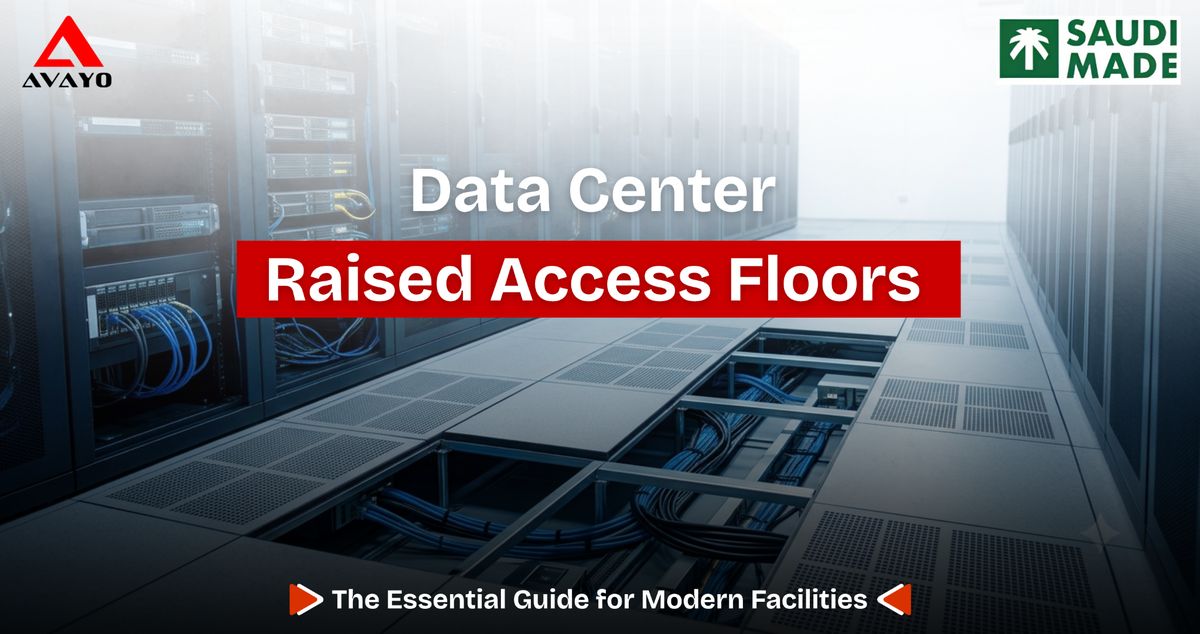
In today’s digital world, data centers play a crucial role in supporting cloud computing, enterprise operations, and many large-scale digital services. As these facilities handle more data and require nearly constant uptime, every part of the physical setup needs to work seamlessly. One of the most important, yet sometimes overlooked, features is the raised access floor.
Raised access floors are elevated platforms built above the main floor slab, creating a useful space underneath. This area helps manage airflow, organize cables, carry heavy equipment, and allows for quick changes or upgrades. Choosing the right raised floor system can have a big impact on cooling, flexibility, costs, and long-term reliability for data centers in the Middle East and around the world.
This guide explains why raised access floors matter for data centers, covers their main benefits, key technical points, installation tips, and highlights how companies like Avayo create reliable solutions for tough environments in Saudi Arabia, the UAE, and the GCC.
What Are Raised Access Floors?
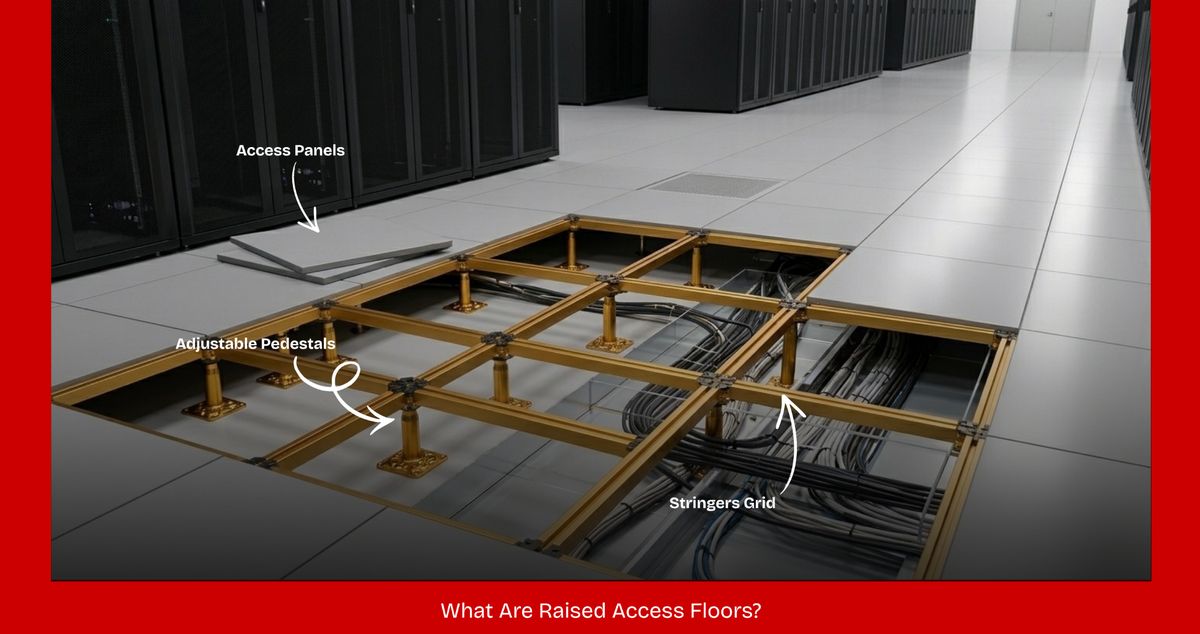
A raised access floor is a modular system of individual panels—typically 600 mm × 600 mm—supported by a grid of adjustable steel pedestals (and often stringers). The finished floor height can range from as low as 35 mm for low-profile applications to 1,500 mm or more for high-density data halls requiring substantial cable volume and airflow capacity.
The void beneath the panels, known as the plenum, serves multiple purposes simultaneously:
- Distribution of chilled air via underfloor air distribution (UFAD)
- Routing of power cables, busbars, and PDUs
- Organization of fiber and copper data cabling
- Accommodation of liquid cooling piping or fire-suppression lines
- Easy, non-disruptive access for maintenance and future changes
Unlike solid concrete floors, where cables and services are stuck in place or have to run overhead, raised access floors turn the floor into a flexible and accessible space. This flexibility is essential in data centers where equipment and layouts are always changing.
Why Raised Access Floors Are Essential for Data Centers
Modern data centers face relentless pressure to improve Power Usage Effectiveness (PUE), support higher rack power densities (often exceeding 20–30 kW and rising), minimize downtime, and scale rapidly. Raised access floors address these challenges across five primary dimensions.
1. Cooling Efficiency and Airflow Optimization
Cooling typically accounts for 30–40% of a data center’s total energy consumption. Underfloor air distribution remains one of the most effective strategies for delivering cold air precisely where it is needed.
In a raised floor system, computer room air conditioning (CRAC) or computer room air handler (CRAH) units supply chilled air into the pressurized plenum. Perforated or high-flow airflow panels then release this air into cold aisles. Combined with hot-aisle or cold-aisle containment, the approach dramatically reduces air mixing, eliminates hot spots, and allows higher supply-air temperatures—all of which improve PUE.
Avayo’s range includes precision-engineered airflow and perforated panels (available in 20% and 40% open area configurations, among others). These panels maintain structural integrity while optimizing airflow. Proper placement, guided by computational fluid dynamics (CFD) modeling, ensures that cooling capacity matches the IT load without wasteful over-provisioning.
Sealing is equally important. Cable penetrations, perimeter edges, and equipment bases must be properly gasketed or sealed to maintain plenum pressure and prevent leakage. When executed correctly, raised-floor UFAD systems can reduce cooling energy use by 20–40% compared with traditional overhead approaches.
2. Superior Cable Management and Power Distribution
High-density data centers generate dense webs of power and data cables. Overhead trays quickly become congested, create airflow obstructions, and complicate moves, adds, and changes (MACs). In-slab conduits offer almost no flexibility once poured.
The raised floor plenum solves these issues by providing organized, segregated pathways. Power cabling and busways can run separately from fiber and copper data cables. Technicians lift individual panels to access, reroute, or add services without affecting adjacent operational racks. This zero-disruption capability is invaluable for facilities that must maintain continuous uptime.
Avayo systems support finished floor heights from low-profile office applications up to 1,500 mm, giving designers ample room for high-volume cabling and future expansion. Complementary products such as floor boxes further enhance accessibility by bringing power and data outlets neatly to the working surface.
3. Load-Bearing Capacity and Structural Integrity
Server racks, especially fully populated high-density units, can exceed 1,500 kg. The floor must support concentrated point loads from rack casters or feet, uniformly distributed loads across the data hall, and dynamic loads from personnel and equipment movement—without excessive deflection or permanent deformation.
Data-center-grade raised floors are rigorously tested for concentrated, uniform, and ultimate load ratings according to standards such as CISCA, ASTM, and ANSI. Typical concentrated load ratings for mission-critical panels range from 3.5 kN upward to significantly higher values for heavy-duty applications.
Avayo manufactures a full spectrum of panels:
- Cement core (steel-encapsulated) panels for high strength and durability
- Calcium sulphate core panels offering excellent fire performance, dimensional stability, and acoustic properties
- Wood core panels for specific commercial requirements
- Specialized airflow/perforated panels that balance open area with load capacity
Pedestal and stringer systems provide the necessary lateral stability and load distribution. For higher floor heights or seismic zones, heavy-duty stringered systems are recommended. Avayo’s manufacturing facility in Saudi Arabia produces panels that meet international performance criteria while ensuring fast regional delivery and compliance with local project requirements.
4. Energy Efficiency, Sustainability, and Longevity
Raised access floors contribute to sustainability on multiple fronts. Optimized cooling directly lowers energy consumption and associated carbon emissions. The modular nature of the system means the data hall can be reconfigured repeatedly over decades without demolition waste. Many panel cores incorporate recycled content, and the steel components are fully recyclable at end of life.
Calcium sulphate panels, in particular, offer favorable environmental profiles due to the use of industrial by-products and lower thermal conductivity compared with pure steel constructions in certain applications. A well-designed raised floor extends the useful life of the building shell by keeping the facility adaptable to evolving IT and cooling technologies, including emerging liquid-cooling deployments.
5. Safety, Security, and Operational Continuity
Concealing all cabling eliminates trip hazards and creates a clean, professional walking surface. Individual panels or zones can be locked to control physical access to critical infrastructure. High-quality panels carry strong fire ratings and, when combined with proper fire-stopping at penetrations and plenum barriers, support compartmentalization strategies.
In the event of equipment changes or incidents, rapid underfloor access minimizes mean time to repair. These attributes collectively enhance both personnel safety and facility security—non-negotiable requirements in mission-critical environments.
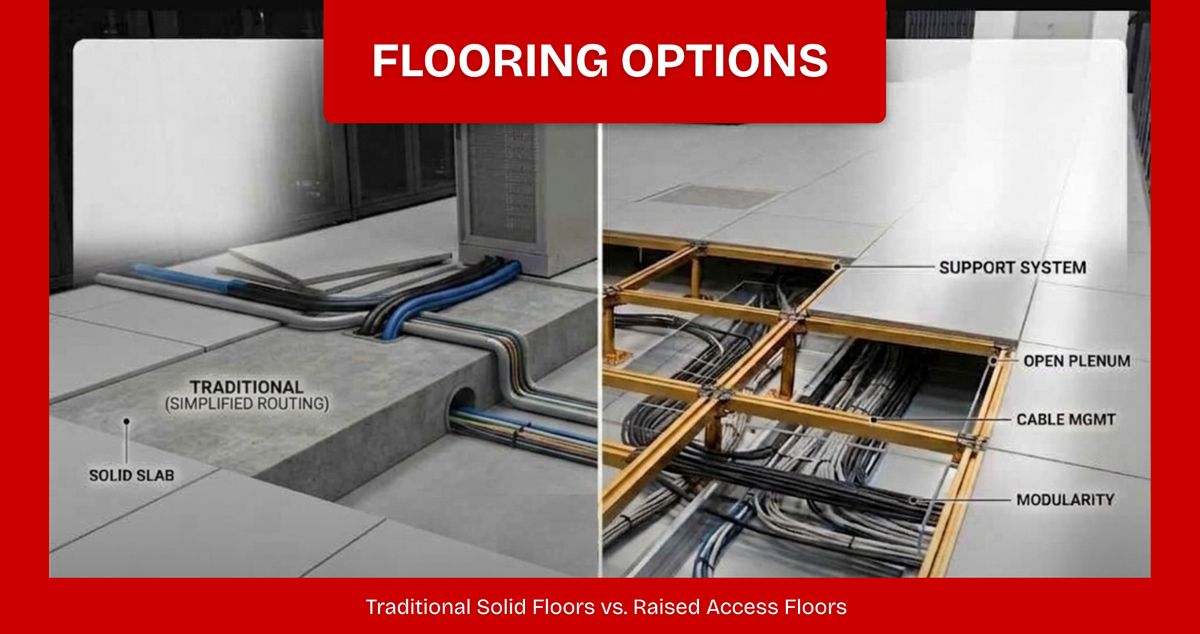
Comparison: Traditional Solid Floors vs. Raised Access Floors
When comparing traditional solid floors to raised access floor systems, several key operational and financial differences emerge. Traditional solid slabs offer limited cooling efficiency that is prone to air mixing and hot spots, whereas raised access floor systems provide excellent under-floor air distribution (UFAD) and containment capabilities. For cable access and management, traditional floors are difficult, disruptive, and expensive, while raised access floors allow for immediate and non-disruptive handling.
In terms of flexibility and scalability, traditional slabs have minimal adaptability once constructed, whereas raised floors offer maximum flexibility as layouts can evolve freely. Deployment speed also favors raised systems, allowing IT fit-outs to proceed independently, whereas traditional services must be finalized early. Financially, traditional floors have lower initial capital expenditures (CapEx) but higher long-term operational expenditures (OpEx), whereas raised floors feature a higher initial CapEx that is offset by energy and move, add, and change (MAC) savings. Finally, while traditional floors are constrained by overhead solutions regarding density support and have limited future-proofing, raised access floors are designed for high and growing kilowatt-per-rack density and offer excellent future-proofing, including liquid cooling readiness.
Although a quality raised floor costs more upfront, it usually pays for itself in a few years thanks to energy savings, less downtime, and lower costs for future upgrades—especially in busy data centers.
Key Technical Considerations When Specifying Raised Floors
Panel Type and Core Material
Cementitious steel-encapsulated panels dominate data center applications because of their strength-to-weight ratio, durability, and cost-effectiveness. Calcium sulphate cores excel in fire resistance and stability. Wood core options suit lighter commercial uses. Avayo offers all major types, allowing project-specific selection.
Load Ratings
Specify concentrated load (critical for rack feet), uniform load, and ultimate load. Always include a safety margin for future density increases.
Finished Floor Height
Typical data center heights range from 300–600 mm for moderate density to 900–1,200 mm+ for high-density or extensive cabling. Greater height improves airflow capacity and cable volume but increases cost and structural requirements.
Airflow Performance
Match perforated panel open area and placement to the cooling design. Avoid excessive open areas that can depressurize the plenum or create uncontrolled airflow.
Understructure
Stringer systems improve rigidity, vibration resistance, and load sharing—especially important for taller floors and high-traffic or high-load zones. Pedestals must be adjustable, corrosion-resistant (galvanized steel is standard), and properly anchored or adhered to the slab.
Surface Finish
High-pressure laminate (HPL), vinyl, or bare finishes are common. Anti-static properties are essential; surface-to-ground resistance should typically fall within accepted data center ranges (often 10⁶–10¹⁰ ohms). Carpet is generally avoided due to dust and static concerns.
Standards and Compliance
Look for systems tested to CISCA, ASTM, ANSI, and relevant regional or client specifications (e.g., Aramco, SEC approvals in Saudi Arabia). Seismic performance may be required in certain locations.
Integration with Other Systems
Coordinate early with MEP designers for cable trays, busways, air dams, and liquid-cooling infrastructure. Floor boxes, grommets, and seals maintain both accessibility and plenum integrity.
Installation Best Practices
Successful performance depends as much on installation quality as on product selection:
- Substrate preparation – Achieve high floor flatness (FF) and levelness (FL) numbers. Laser leveling is standard.
- Pedestal layout – Precise grid setting ensures uniform support and proper panel seating.
- Stringer installation – Creates a rigid framework that distributes loads and reduces panel movement.
- Panel placement and leveling – Panels must sit firmly without rocking. Perforated tiles follow the airflow design.
- Sealing and integration – Install grommets, perimeter seals, and coordinate with other trades to preserve designed airflow paths.
- Final verification – Load testing, airflow measurements, and visual inspections confirm readiness.
Avayo’s regional manufacturing presence in Saudi Arabia supports rapid delivery, local technical support, and familiarity with GCC project requirements and climatic conditions.
Long-Term Maintenance
A properly installed raised floor requires relatively modest maintenance:
- Periodic inspection for loose panels or debris in the plenum
- Cleaning of perforated tiles to maintain airflow
- Checking and replacing seals/grommets as needed
- Adherence to original load ratings when adding equipment
- Documentation of any modifications
With routine care, high-quality systems deliver reliable service for 20–25 years or longer—matching or exceeding the design life of many data centers.
The Avayo Advantage for Data Center Projects
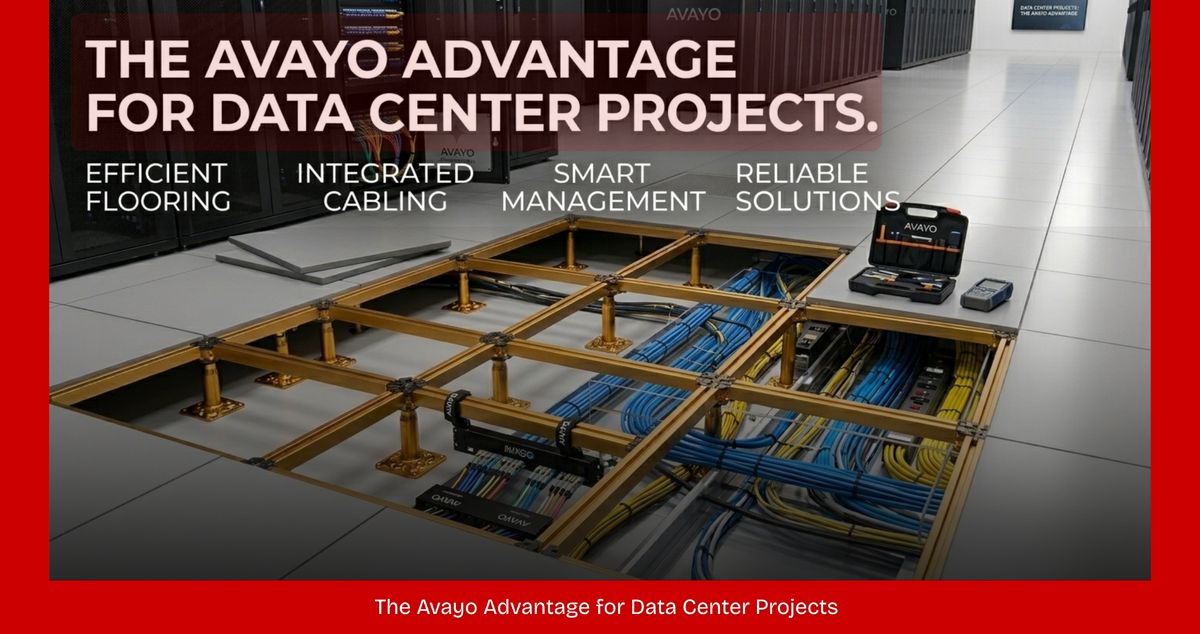
Avayo manufactures raised access flooring systems in an advanced Saudi Arabian production facility, ensuring consistent quality, competitive lead times, and full compliance with international standards (CISCA, ANSI, ASTM). The product range covers:
- Cement core, wood core, and calcium sulphate panels
- Airflow and perforated panels optimized for data center cooling
- Compatible pedestal and stringer understructures
- Supporting accessories such as floor boxes
These solutions serve data centers, control rooms, commercial offices, and technical facilities across the Middle East. Local production capacity, combined with engineering support and a track record of approvals from major regional organizations, positions Avayo as a reliable partner for both new builds and upgrades.
Whether the requirement is a high-density hyperscale hall in Riyadh or Jeddah, an enterprise data room in the UAE, or a specialized technical facility elsewhere in the GCC, Avayo systems are engineered to deliver the strength, airflow performance, and accessibility that modern digital infrastructure demands.
Looking Ahead: Future-Ready Flooring
As rack densities continue to rise and liquid cooling (direct-to-chip or immersion) gains traction, raised floors remain highly relevant. The plenum provides ideal routing space for coolant piping and leak-detection systems. Deeper plenums accommodate greater air volumes or hybrid air/liquid architectures. Emerging “smart floor” concepts may integrate sensors for real-time monitoring of pressure, temperature, or security.
Facilities that invest in robust, well-designed raised access floors today position themselves to adapt efficiently to these evolutions without costly structural interventions.
Frequently Asked Questions (FAQ)
Q: What is the optimal plenum height in a modern facility?
A: In the past 600mm was the norm. But with increasing power densities, many new hyperscale facilities are shifting to 900mm or even 1200mm to carry larger quantities of chilled air and thicker power busways.
Q: Are these flooring suitable for robotics?
A: Yeah. Modern data center-grade flooring can be designed to handle the dynamic loads of Autonomous Mobile Robots (AMRs) used for hardware maintenance.
Q: How do you avoid condensation in the plenum?
A. Condensation is controlled by design, such as vapor barriers on the base slab, good quality panel insulation, and exact dew point management of the air being supplied.
Conclusion
Raised access floors aren’t just a convenience—they’re a key part of making sure data centers stay cool, organized, flexible, and efficient over the long term. In an industry where even a few minutes of downtime can be very costly, and energy efficiency really matters, the type of floor you choose is a big decision.
By selecting high-performance panels, properly engineered understructures, and partnering with experienced regional manufacturers such as Avayo, operators can build facilities that perform reliably today while remaining adaptable for the demands of tomorrow.
For project-specific technical guidance, load calculations, airflow recommendations, or quotations on Avayo raised floor systems, contact the Avayo team. Their local manufacturing capability and deep expertise in Middle East data center and commercial infrastructure make them well-equipped to support mission-critical deployments across Saudi Arabia and the wider region.
Choosing the right raised access floor means better uptime, greater efficiency, and being prepared for the future—the real building blocks of a successful data center.